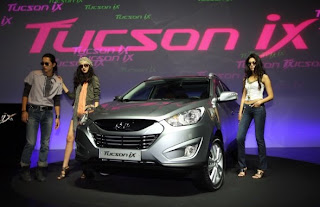


Hyundai unveiled the all-new Tucson crossover in the South korean market yesterday!


Hyundai Motor Company has issued its monthly sales report in which, the company has announced it has sold 307.181 new cars in September 2009, a 61% increase compared to the same month a year earlier.
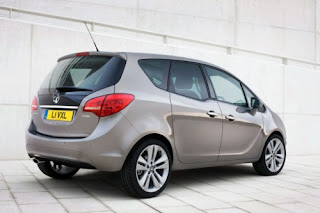
Opel has released the very first photos of the all-new Meriva mini-MPV ahead of it official unveiling. The all-new Meriva is scheduled to make its official premiere at the upcoming Geneva Auto Show in March.
MANILA, Philippines - With its functional styling, solid build quality, a choice between fuel-efficient gasoline and common-rail diesel engines, and a price tag that’s hard to beat, the Hyundai Tucson has been a perennial hot-seller in the compact SUV stakes.
And while that state of affairs might cause some automakers to rest on their laurels, Hyundai had absolutely no intention of doing so. Hence the head-turning all-new 2010 Tucson that was unveiled to much Gary V.-led song-and-dance fanfare last week at the A. Venue hall in Makati Ave.
With its provocative front end and curvaceous lines, the 2010 Tucson’s head-turning styling should handily vault it to the top of the wishlist of people shooping for a compact SUV. The flowing and graceful design starts at the front with a sexy hood character line, followed by a “Z” form side character line that exhibits a strong and artistic 3-dimensional embellishment for a dynamic sports car-like profile.
This sporty theme is continued at the rear, with sharp-looking taillights, an oversized two-tone rear bumper, a rear spoiler, and a sloping backlight.
Putting even more attitude to the all-new Tucson’s style is Hyundai’s new design identity – a hexagonal grille in chrome and high-gloss black. Tracing its roots to the Hyundai ix-onic concept previewed at the 2009 Geneva Auto Show, this design is the new defining face of Hyundai’s family of future automobiles, beginning with the all-new Tucson.
2010 Hyundai i-flow Concept
The 2010 Geneva Motor Show is over, but we realized that we missed out on covering one significant vehicle: Hyundai's i-flow diesel hybrid concept.
While the first gasoline hybrid was the 1997 Toyota Prius, only this year will French maker Peugeot introduce the world's first production hybrid with a diesel engine, the 2011 Peugeot 3008 Hybrid4. Mercedes-Benz will follow with its 2012 E 300 Bluetec Hybrid.
Despite that pair, hybrid concept cars with diesel engines are still very much the exception. And they're even rarer from Asian manufacturers, who haven't historically offered diesel engines either in their home markets or for export--at least until recently.
But in the uber-European show at Geneva, Hyundai rolled out the i-flow Concept, whose shape previews its next large car, which will likely replace the current Hyundai Azera sedan and arrive next year as a 2012 model.
Designed by the company's German design studio in Russelsheim, the i-flow concept uses many of the same lines as the new 2010 Hyundai Sonata that is now on sale. Its drag coefficient is quoted as 0.25, the same as the slippery 2010 Toyota Prius hybrid.
Hyundai conducted minor tweaks to the ‘GK’ model in 2005, for the outgoing named 2006. The vehicle incorporated reworked sleeker blackened headlights, redesigned rear tail lights, a different range of alloy wheel designs, colored stitching on leather seats (half leather seats available for the 1.6 range). A popular modification, as promoted on www.newtiburon.com, saw owners of the 2003 vehicle removing the air-filter resonator box. The resonator box was located directly in front of the front left hand side wheel, behind the fender. This allowed for a greater airflow to the air filter, gaining a minimal increase of (BHP). Hyundai, seeking cost cuts, adopted this modification for 2004+ models.
The 2007 model has seen minor changes in interior & exterior design. Most notably the previously amber gauge and button lighting has been changed to blue and white, similar to what can be found in the line. Exterior changes include muted side scalloping, new headlights and grille design and revised tail lights.
The action—which affects 46,000 cars in South Korea and 1,300 in the U.S.—came after customers in the U.S. complained that, in certain circumstances, the latch gets stuck after the door is opened and then can't be closed.
A company spokeswoman said the problem happens when a passenger simultaneously pulls the door latch and holds down the lock, an unusual circumstance but common enough to send the company scrambling for a fix.
There have been no accidents or injuries reported to the company in connection with the problem. But it came at a time of increased scrutiny on vehicle flaws, shaped mainly by troubles at Toyota Motor Corp., the world's largest auto maker by vehicle sales. That company in recent weeks has been forced to recall several models to deal with quality issues. Toyota President Akio Toyoda was set to appear before U.S. lawmakers Wednesday.
Shares in Hyundai Motor fell 2.6% on the Korea Stock Exchange after news of the recall emerged. Some analysts said they believed investors overreacted and that the financial impact of the recall would be minimal.
Many would consider Hyundai to be a novice in the sports car segment and rightly so- they are new to this field. The brand can̢۪t be expected to deliver the best and be in competition with the high players for another couple of years. May be in the next decade, they will be one of the decent competitors.
Most would think the above things and would be wrong because it sure looks like Hyundai did their homework and only then came up with the 2007 Hyundai Tiburon. This sports car coupe base model comes in less than $17,000. Surprised? So were we. An unbelievable price for a sports car. But what is more unbelievable is that it actually is not a bad model at all and delivers more than it promises. The Tiburon is very new and is also a very big threat to the big boys. They better buckle up.
The car looks like a typical sports car- just what the market wants. The body is nice and rounded and gives an impression of being really smooth- which it is. The side lines are rakish in style- not so structured and it adds to the appeal of the sports car.
Next up, let̢۪s talk about the engine. It has a regular V6 engine and gives about 172 HP. Not bad at all. The suspension is really remarkable and the handling so smooth and easy, it beats the competition big time.
The interiors are also done up in style. The indicators are all in a stylish blue light and the rear view makes you feel like you are in a sports car.
As the world gears up to face the challenges of the on-going fuel crisis, economical downturn and environmental issues, Hyundai strives to meet the challenge with its latest version of the 2010 Tucson. In an effort to stand high as the global leader in the present economy, the new Tucson, despite its few minor shortcomings, is promoted with emphasis on its high EPA rating. After all 23 miles in the city and 31 on the highway per gallon, is not something that every vehicle in the SUV genre can boast off.
Featuring an engine that pumps out 176 hp and 168 lb-ft of torque at 6000 rpm, the Tucson’s figures are not something impressive enough but, the drive is an entirely different story. Sporting MacPherson struts in the front, and a sporty multi-link setup in the rear, the Tucson maneuvers corners like nothing else. It is exceptionally flat on its body, and there is virtually no body roll. With regards to weight, it is relatively lighter than its counterparts. This can be a reasonable explanation for why this is highly agile and fast in the corners. It has a six-speed automatic transmission, which, Hyundai claims, further aids in the high mileage.
Though the shape of the Tucson is not very appealing, there is an element of slight quality in the design. The new sheet metal design and the sloping hood with the highly raked windshield combined with the grille yields a distinctly pleasant sight. From the side this does not look too classy, and the rear is fine but then few SUV’s ever need a different word to be said in that.
According to Hyundai, the i-Flow concept is a preview of the D-segment mid-size saloon contender that “carries forward the company’s evocative new ‘fluidic sculpture’ philosophy.” The flowing, elegant lines are joined by the long tail and the short front overhang along with low roofline and swoopy styling that combine to give the concept a futuristic look.